How the game works
Players choose a broker scenario, upgrade infrastructure buildings, respond to broker events, manage A-book, B-book, or hybrid execution, and finish the run with a PDF-ready infrastructure diagnosis.
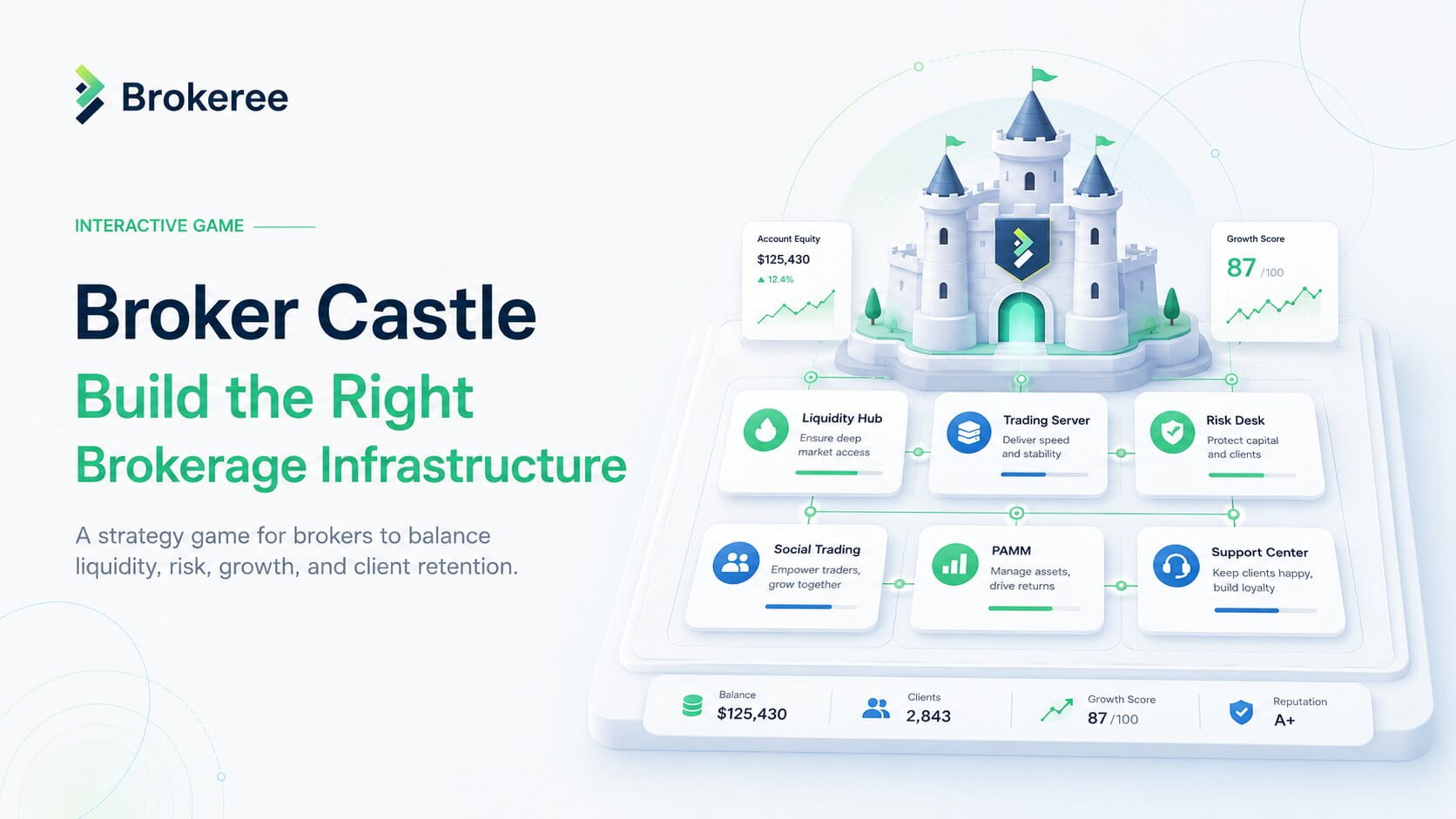
Broker Castle is an interactive simulation by Brokeree where players build and diagnose a brokerage infrastructure stack. The game translates real broker challenges into a playable economy: liquidity, execution quality, trader retention, risk exposure, server load, managed accounts, copy trading, prop trading, and operational scalability.
Players choose a broker scenario, upgrade infrastructure buildings, respond to broker events, manage A-book, B-book, or hybrid execution, and finish the run with a PDF-ready infrastructure diagnosis.
The game includes Liquidity Bridge, Social Trading, PAMM, Prop Pulse, Dynamic Margin, Swap Manager, liquidity routing, toxic flow, server load, retention, provider ranking, challenge accounts, and managed accounts.
The simulation helps teams discuss how broker infrastructure choices affect growth, risk, execution quality, engagement, and client trust before the next stage of scaling.
Broker Castle is designed for brokerage teams, sales teams, product marketers, business development managers, and infrastructure decision-makers who want to explain broker technology trade-offs in a more interactive way.
The final report summarizes the broker scenario, infrastructure bottlenecks, risk profile, product fit, recommended Brokeree stack, discovery questions, and a shareable result for follow-up conversations.
Broker Castle is a brokerage infrastructure strategy game by Brokeree. It lets players simulate how infrastructure decisions affect broker growth, trust, liquidity, risk, trader retention, and operational capacity.
No. Broker Castle is an educational and marketing simulation. It does not provide trading, investment advice, brokerage services, or access to financial markets.
The game references Liquidity Bridge, Social Trading, PAMM, Prop Pulse, Dynamic Margin, and Swap Manager as infrastructure concepts and recommended solution paths.
The goal is to build a scalable brokerage infrastructure over 24 months while balancing liquidity, risk, server capacity, retention, trust, traders, revenue, and market events.
At the end of a run, Broker Castle evaluates the broker profile, execution model, infrastructure bottlenecks, primary pressure point, and recommended Brokeree stack. The player can copy the result or download a PDF-ready report.
Yes. The game can support lead generation, product education, internal demos, campaign landing pages, and discovery conversations with brokers.
Broker Castle simulates liquidity stress, server load, risk exposure, support backlog, compliance pressure, churn pressure, infrastructure debt, product adoption, and board-level scaling readiness.
Build a brokerage over 24 months. Growth creates pressure, pressure creates incidents, and only the right infrastructure stack keeps the broker alive.
A new infrastructure situation requires your decision.
A compact glossary for the infrastructure terms used in Broker Castle. Use it as a quick reference while playing.
Each scenario changes the starting economy, pressure points, and recommended Brokeree infrastructure path. You can still build any product stack, but the run will feel different.
Broker Castle is a brokerage infrastructure simulator. Start like in a strategy simulation economy: build the storage/execution layer first, then scale growth, engagement, and risk controls.
Liquidity Hub is the economic storehouse. Without it, execution quality drops and traders do not stay.
A-book is safer and trust-led. B-book brings stronger early margin but needs Risk Desk sooner.
Marketing creates leads, but if support, server capacity, and liquidity are weak, growth becomes pressure.
Social Trading and PAMM improve retention, activity, and monetization once the execution base is stable.
Risk Desk, research, support, and liquidity routing protect the business during volatility and crises.
At the end of a run, export the PDF-ready infrastructure report and use it as a Brokeree sales conversation starter.
Build a brokerage infrastructure like an economic strategy game. Your Trading Server is the castle keep. Liquidity, risk, support, and engagement systems decide whether growth becomes a scalable business or a collapse.
Select a background track. This list is scrollable, so you can keep adding more MP3 files later.
Select the situation that feels closest to your business. This changes your early bottlenecks, risks, and product-fit recommendations.
You are launching and need trust, liquidity, and a clean first client experience.
You already have traction, but operations, support, and server load are tightening.
You want stronger margin, but exposure control and toxic flow become urgent.
You can generate leads fast, but client quality and support pressure vary.
You face fast campaigns, active traders, and sharper risk-control requirements.
You operate across platforms and need integration quality, uptime, and routing.
Your Liquidity Hub is online. Now choose the business model that will define your broker economy.
Route client flow to external liquidity. Safer and more trusted, but lower early margin.
Internalize flow and earn more early revenue. Dangerous without a Risk Desk.
Locked for now. Later you can combine A-book and B-book logic when your infrastructure is mature.
A new situation requires your decision.

Upgrade Liquidity Hub to start the broker economy and unlock execution model selection.
Execution quality, A-book route, liquidity stability.
Your brokerage core. If it overloads, traders leave.
Execution quality, A-book route, liquidity stability.
Controls exposure, volatility losses, toxic flow.
Boosts engagement, retention, and trading volume.
Reduces churn and protects trader satisfaction.
Attracts traders but increases infrastructure pressure.
Managed accounts, higher value clients, more trust.
Challenge stages, trader scouting, account rules.
Audit readiness, reporting, and regulatory pressure.
Deposits, withdrawals, chargebacks, and cash access.
Build your brokerage infrastructure stack.
Trader care removes support backlog more reliably and reduces monthly churn pressure.
Cost: 4 RP · Time: 1mImproves lead conversion and weakens lead-quality drops from aggressive campaigns.
Cost: 5 RP · Time: 1mReduces toxic-flow pressure, B-book shocks, and volatility losses.
Cost: 7 RP · Time: 1mImproves liquidity stability and makes LP negotiation more effective.
Cost: 7 RP · Time: 1mImproves platform integrations, reports, and server incident recovery. Unlocks top-tier server and liquidity upgrades.
Cost: 7 RP · Time: 2mRequires Risk AI. Reduces risk spikes during volatile and prop-heavy runs.
Cost: 9 RP · Time: 2mImproves pricing transparency, trust, retention, and managed-account monetization.
Cost: 5 RP · Time: 1mRequires Social Trading. Turns engagement into acquisition and trust.
Cost: 6 RP · Time: 1mRequires Prop Pulse. Improves challenge conversion and reduces prop risk.
Cost: 6 RP · Time: 1mRequires Compliance Office Lv. 1. Unlocks Compliance Office Lv. 2 and Regulatory Reporting Pack.
Cost: 6 RP · Time: 1mRequires Compliance Office Lv. 1 or Payment Operations Lv. 1. Unlocks Payment Operations Lv. 2.
Cost: 7 RP · Time: 1mRequires Compliance Workflow Automation. Unlocks Compliance Office Lv. 3 and Payment Operations Lv. 3.
Cost: 9 RP · Time: 2mRequires REST / FIX Ops. Reduces active pressure duration and crisis damage.
Cost: 10 RP · Time: 2mSmart liquidity aggregation, routing, execution quality, and LP/gateway connectivity. Execution layer · Learn more →
Copy trading, provider discovery, engagement, and client retention mechanics. Engagement layer · Learn more →
Money manager and investor infrastructure with automated profit distribution. Investment layer · Learn more →
Challenge account management for prop firms, evaluation stages, and trader scouting. Prop layer · Learn more →
Flexible margin and leverage rules by account, group, symbol, and market condition. Margin layer · Learn more →
Custom swap fee rules, swap-free periods, and balance-operation processing for MT4/MT5. Swap layer · Learn more →